Choosing a care community for a parent in Greenwich, Connecticut, is a decision most families make once, under pressure, with little to compare it against. The two phrases that come up first, assisted living and memory care, sound close enough to be used interchangeably. They are not.Assisted living is for people who need help with daily care. The National Institute on Aging lists assistance with personal care and help with medications, housekeeping and laundry among its services.Memory care is narrower. It is care built around people living with memory impairment, which changes how staff are trained, how a day is put together, and how someone is spoken to when the words will not come.In Greenwich, Connecticut, The Greens at Greenwich sits where those two descriptions meet: one building, one care level, assisted living, with memory care as the specialty throughout it. Reading this comparison alongside dementia care at The Greens at Greenwich will tell a family more than a feature list will.
The difference between memory care and assisted living at The Greens at Greenwich
Assisted living supports people who need help with daily activities: dressing, bathing, meals, medications, getting from one part of the day to the next. The support is practical, organized around what a person can no longer manage alone.Memory care starts somewhere else. It is organized around memory impairment itself, so the questions a family should ask change. Rather than asking how much help is on hand, ask how staff are trained in the care of people with various dementias, how activities are matched to one person’s history and interests, and what happens on a day when conversation is difficult.Not every assisted living community specializes in memory care, so the service name on the sign is not the answer. The Greens at Greenwich is a memory care assisted living community. Memory care is not a department inside it. It is the specialty of the whole community. That means the comparison a family is really making is not assisted living against memory care, but one community’s approach against another’s.
When families start to consider memory care at The Greens at Greenwich
Families usually start asking the question when a parent is struggling with familiar routines, with everyday conversation, or with activities they used to enjoy. Changes like those prompt the question of whether more support would help.The National Institute on Aging notes that dementia ranges in severity “from the mildest stage, when it is just beginning to affect a person’s functioning”, and that signs and symptoms vary depending on the type. In the early stages, it may be possible for people to continue with their everyday activities. A diagnosis on its own does not set a person’s support needs, and two people with the same diagnosis can need very different days.One person may need more help with daily tasks while another finds conversation or a long-loved hobby harder to hold on to. Talking those observations through with care professionals is how most families work out what they are looking for.The Greens at Greenwich puts the case for a move in careful terms: “Now we know more about the disease and understand that transitioning to a memory care assisted living community is often more beneficial than staying at home with one caregiver.” Note the word “often”: it is not a promise.
How The Greens at Greenwich approaches memory care
The Greens at Greenwich is a small privately owned assisted living community for people living with memory impairment. It has been providing excellence in memory care to the community for over 20 years, at 1155 King Street in Greenwich, Connecticut, in a residential neighborhood on the Greenwich/Westchester border. In the community’s own words, The Greens is small in size and big in care.The Greens at Greenwich is a Purple Flag community accredited for its excellence in memory care by the Connecticut Assisted Living Association and the Alzheimer’s Association.Care is planned one person at a time. The community writes individualized care plans at The Greens at Greenwich that focus on a resident’s strengths, to support their independence and keep their best quality of life. Staffing published for the community includes 24 hour staff, licensed staff, RN and LPN, and resident care attendants. Many staff have been there more than ten years.Training is ongoing rather than one-off. Twice monthly, staff attend sessions on topics including The Biology of the Brain, The Power of Music on the Brain, and Comforting an Anxious Moment. Care is all inclusive: the community’s position is that a resident’s needs will change but the cost of care will remain the same.
Creative arts therapies at The Greens at Greenwich
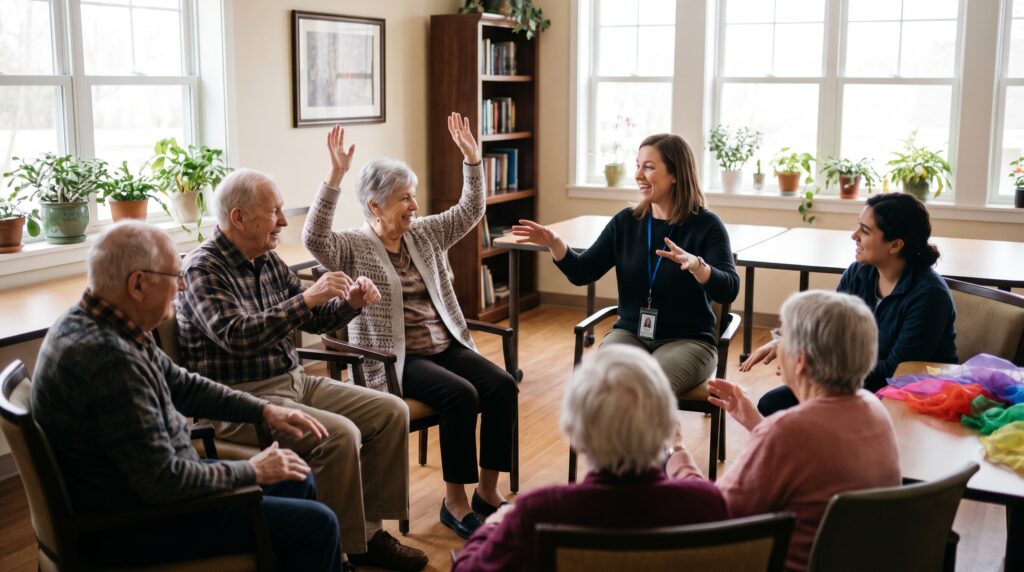
Where language fails, the arts speak. That is the idea the whole program rests on, and the disciplines are art, music, dance/movement, drama and storytelling, organized as Lifestyle at the Greens: The C’s of Connection.The Greens at Greenwich is the only assisted living community in Connecticut with licensed and board-certified therapists on staff in all the creative arts. Research tells us that being involved in the arts can affect thousands of neural pathways and help release thoughts and feelings that cannot be expressed through words.In practice that looks like named partnerships and recurring events rather than an activities calendar. There is an Artist-In-Residence program with SUNY Purchase, a buddy program with Sweet Readers that matches students with residents, and pet therapy with The Good Dog Foundation. Summer brings the Annual Concert on the Green, Jazz in the Garden, Ice Cream Parlor on the Porch, and The Greens Palette.Families can read more about the care programs at The Greens at Greenwich and about how The Greens at Greenwich cares through creative arts therapies.
What families compare when choosing memory care at The Greens at Greenwich
Comparing communities comes down to four things: who the staff are, what fills a day, where a parent will live, and how the community talks to a family after the move.
Staff experience and training
Ask how staff are trained, how often, and on what. Ask what they do when communication breaks down, when a routine changes, or when someone is anxious at four in the afternoon. Ask how long the people on shift have worked there, because staff who stay are staff who know a resident’s history.
Activities and personal interests
Ask what a Tuesday looks like. At The Greens at Greenwich, exercise is a daily part of life, with yoga, Tai Chi, Zumba, Stretch and Strengthen, and a Walking Club. There are weekly outings to museums, aquariums, restaurants, ferry rides, ice cream and picnics. Interfaith, Christian and Shabbat services are offered, along with Bible study and Judaica presentations, and the community honors all faiths and traditions.
Accommodation and environment
Published accommodation at The Greens at Greenwich is one bedroom, studio and shared suites. There is a secured area, and common areas include a safe and secure outdoor garden. Meals are chef prepared, and the Executive Chef is part of resident life: the chef may be talking about food with a resident or taking a stroll with them in the garden. The full list sits on the services and amenities at The Greens at Greenwich.
Communication with families
Ask how the community shares updates, how it responds when a family raises something, and what it does with what a family notices. At The Greens at Greenwich, families and friends are treated as part of the community’s village, and all persons are treated with respect and seen as whole people whose needs have shifted due to circumstance.
Deciding whether The Greens at Greenwich is the right fit for your family
The useful questions are concrete. Ask how a day would be built around a parent who likes to walk, or who wants the radio on, or who was a serious cook, and how support changes as needs change.Visit, and visit at a time of day that is hard rather than easy. A family will learn more from watching one ordinary afternoon than from any brochure, including this one.
Contact The Greens at Greenwich
Deciding on memory care can bring grief, guilt and the fear that a move is a betrayal. Looking at care takes nothing away from the years a family has already given, and the point of more support is to help a parent keep their dignity, their comfort and their connection to other people.The Greens at Greenwich is at 1155 King Street, Greenwich, CT 06831. The contact form is on the contact page for The Greens at Greenwich.
Frequently asked questions
How can families involve a parent in a memory care decision?
Invite your parent to say what they want, as far as they are able. Explain things plainly, leave time for the conversation, and include the people whose presence makes them feel steady. Respecting their wishes helps keep their sense of independence.
How can families help a parent feel comfortable during the first few visits?
Keep visits calm and let your parent get used to the surroundings at their own pace. Follow their lead rather than handing them too much at once. Short visits are easier if your parent tires or becomes unsettled.
How can siblings work together when choosing memory care?
Agree on your parent’s main needs, split up the research, and compare notes after each visit. Keeping the conversation on your parent’s well-being takes the heat out of most disagreements. Where opinions differ, go back to what your parent wants.
What personal belongings can help make a new room feel familiar?
Photographs, a favorite blanket and meaningful keepsakes do most of the work. Ask the community what tends to work well in a new room, and bring favorite music or books.
How can families preserve a parent’s sense of identity after a move?
Share the stories, the favorite music, and the details of who your parent is: the work they did, the things they have long been particular about. Family traditions give staff a way to know your parent as a person, not a set of needs.We’re looking forward to speaking with you.Click to call 203.486.8642 or complete the contact form to Schedule a Tour of our Memory Care Community.