

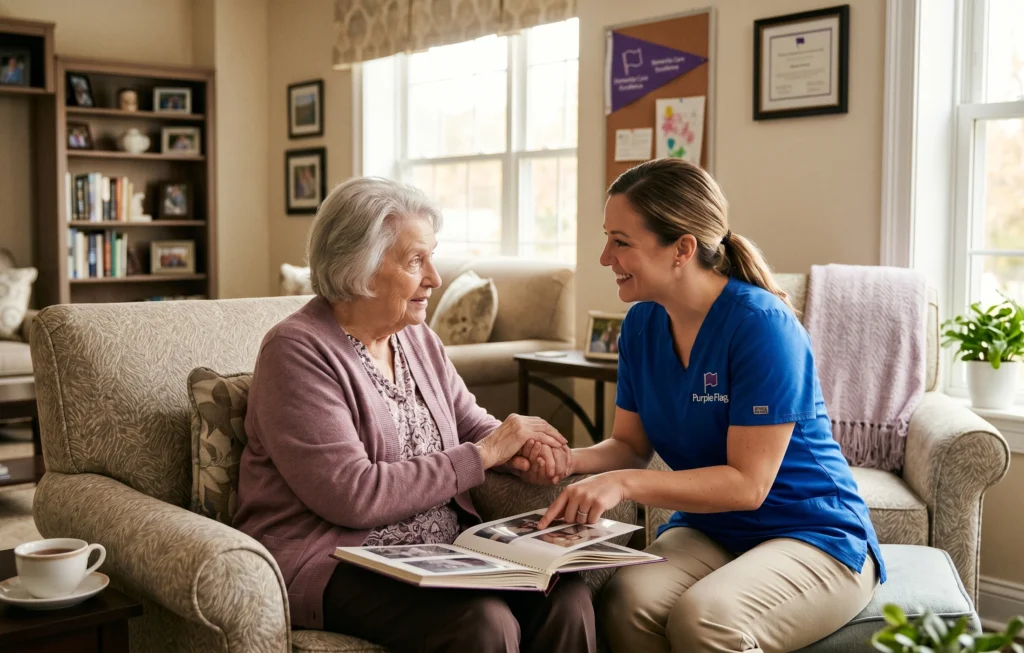
Choosing memory care for a loved one is rarely a simple decision. It often comes with emotional weight, urgent timelines, and a deep desire to ensure the highest possible quality of life. Families are not just looking for a safe place. They are looking for compassionate care, meaningful engagement, and an environment where their loved one can continue to feel like themselves.
This is where standards like Purple Flag dementia care Connecticut become essential. They offer a clear way to identify communities that go beyond basic care and commit to excellence in supporting individuals living with dementia.
At the same time, many families searching for the best memory care Greenwich CT may not realize that initial accreditation is only part of the story. Reaccreditation plays an equally important role, signaling that a community continues to meet high standards over time, not just once.
In this guide, you will learn what Purple Flag Excellence means, what standards are involved, and why reaccreditation is one of the strongest indicators of consistent, high-quality dementia care.
What is Purple Flag Excellence in Dementia Care?
Purple Flag Excellence is a specialized accreditation program designed to recognize senior living communities that provide exceptional care for individuals living with dementia. It focuses not just on meeting minimum requirements, but on achieving a higher, person-centered standard of care.
The program was developed in collaboration with respected organizations such as the Connecticut Assisted Living Association and the Alzheimer’s Association. These partnerships ensure that the standards reflect both clinical expertise and real-world caregiving experience.
At its core, Purple Flag Excellence is about creating an environment where residents with memory challenges can live with purpose, safety, and dignity.
What Makes Purple Flag Different From Other Certifications?
It evaluates how care is experienced in everyday life and not just how it is documented in policies or inspections. This includes attention to emotional well-being, dignity, and meaningful engagement for residents.
As a result, it reflects a more holistic approach to dementia care rather than a checklist-based standard. Here is what sets it apart:
- Prioritizes person-centered care rather than task-based routines
- Evaluates staff training specific to dementia care
- Assesses the physical environment for cognitive support
- Includes family engagement as a core component
- Requires ongoing evaluation, not just a one-time review
This makes it especially relevant for families searching for the best memory care Greenwich CT, where the goal is not just care, but meaningful living.
10 Best Practice Standards Behind Purple Flag Excellence
To earn Purple Flag accreditation, a community must meet comprehensive standards. These standards are designed to cover every aspect of dementia care, from leadership to daily interactions. Institutes like Greens at Greenwich have accredited themselves with Purple Flag Excellence by meeting these values.
These standards can be best explained by the 10 best practices below:
1. Leadership Commitment
Strong leadership ensures that dementia care is not an afterthought. It is embedded in the culture of the community. Leaders set clear expectations for staff and ensure accountability at every level of care delivery. They also play a key role in maintaining consistency, quality improvement, and long-term commitment to best practices.
2. Person-Centered Care
Each resident is treated as an individual with unique preferences, history, and needs. Care plans are tailored to reflect their routines, abilities, and personal life story rather than a standardized approach. This helps preserve dignity and supports a greater sense of identity and familiarity in daily life.
3. Staff Education and Training
Caregivers receive ongoing, specialized training in dementia care techniques and communication. This helps them better understand changing behaviors and respond with patience and empathy in challenging situations. Regular training also ensures staff stay updated on best practices and evidence-based approaches to memory care.
4. Family Partnership
Families are seen as partners in care and not just visitors. They are actively involved in care planning and are encouraged to share insights about their loved one’s preferences and history. Regular communication helps build trust and ensures care remains consistent with the resident’s needs and values.
5. Meaningful Engagement
Residents are offered activities that support cognitive function and emotional well-being. These activities are designed to be purposeful and adapted to individual interests and abilities. This helps encourage participation, reduce feelings of isolation, and create a greater sense of daily fulfillment.
6. Safe and Supportive Environment
The physical layout is designed to reduce confusion and promote independence. Clear signage, familiar design elements, and easy-to-navigate spaces help residents move around with greater confidence. Safety features are thoughtfully integrated so residents can maintain as much freedom as possible while still being protected.
7. Communication Practices
Staff are trained to communicate in ways that reduce anxiety and confusion. They use clear, simple language and a calm tone to help residents feel understood and reassured. Non-verbal cues, patience, and active listening are also emphasized to support more meaningful interactions.
8. Care Planning
Care plans are personalized and regularly updated. They are adjusted as a resident’s needs, abilities, or preferences change over time. This ensures that care remains relevant, responsive, and aligned with each individual’s current condition and goals.
9. Transitions and Continuity of Care
Smooth transitions are ensured when a resident’s needs change. Care teams coordinate closely to maintain consistency in routines, relationships, and support, even as care levels are adjusted. This helps reduce stress for residents and provides families with reassurance that care remains stable and well-managed throughout every stage.
10. Quality Improvement
Communities must continuously evaluate and improve their care practices. This includes gathering feedback from residents, families, and staff to identify areas for growth. Ongoing reviews help ensure that care remains aligned with best practices and continues to evolve with changing needs and standards.
Each one of these practices caters to distinct aspects of memory care, while putting patient well-being at the center of it all. Thus, fulfilling these standards sets a community up for Purple Flag Excellence.
Why Purple Flag Dementia Care Matters in Connecticut?
When searching for Purple Flag dementia care Connecticut, families are often trying to cut through a crowded and confusing landscape of options. Purple Flag provides a clear and trusted benchmark.
In Connecticut, where the demand for high-quality memory care continues to grow, this designation serves as a signal of excellence. It tells families that a community has undergone a rigorous review process and has demonstrated a commitment to best practices.
What Does Reaccreditation Mean and Why Does it Matter?
Achieving Purple Flag status once is impressive, and maintaining it is even more meaningful. Reaccreditation means that a community has been reviewed again after a set period and has successfully demonstrated that it still meets or exceeds the required standards.
This matters for several reasons:
1. Consistency Over Time
Initial accreditation shows capability, but reaccreditation shows consistency. It proves that high standards are not temporary, but are embedded in the ongoing culture and daily practice of care. This long-term validation gives families greater confidence that quality will be sustained over time and not just achieved at a single point.
2. Accountability
Communities must remain accountable to evolving best practices and expectations. Reaccreditation ensures they are regularly reviewed against updated standards rather than relying on past achievements. This ongoing accountability helps drive continuous improvement and reinforces a commitment to delivering high-quality dementia care over time.
3. Continuous Improvement
Reaccreditation encourages communities to refine and enhance their care models. It prompts ongoing reflection on what is working well and where adjustments can improve resident outcomes. This process helps ensure that care practices continue to evolve in line with new research, feedback, and changing resident needs.
4. Staff Retention and Training
Ongoing accreditation often reflects a stable, well-trained team, which is critical in dementia care. Reaccreditation supports continued investment in staff development, ensuring caregivers maintain and strengthen their skills over time. This consistency helps build stronger relationships between staff and residents, which is essential for trust and quality care.
5. Family Confidence
For families, reaccreditation offers reassurance that the quality of care will not decline after move-in. It shows that the community is regularly evaluated and held to the same high standards over time. This ongoing validation helps families feel more secure in their long-term care decisions and trust the consistency of support provided.
In simple terms, reaccreditation is evidence of sustained excellence.
How Reaccreditation Impacts Daily Life for Residents?
It is easy to think of accreditation as an administrative process, but its real impact is felt in everyday moments. For residents, this can mean more consistent routines, familiar caregivers, and environments that continue to be thoughtfully maintained.
Over time, these small details contribute to greater comfort, stability, and a stronger sense of well-being. Reaccredited communities tend to offer:
- More consistent routines that reduce anxiety
- Better communication between staff and residents
- Activities that are thoughtfully designed for cognitive engagement
- Environments that feel calm and supportive rather than clinical
These small but meaningful differences can significantly improve a resident’s quality of life. Moreover, a less obvious benefit of Purple Flag accreditation and reaccreditation is transparency.
Communities that participate in this program are willing to open their practices to external review. This level of openness builds trust with families and sets a higher standard across the industry.
It also means that these communities are more likely to communicate clearly about care plans, changes, and expectations. Thus, when evaluating memory care options, it helps to understand the practical differences.
Below is a quick overview of comparing accredited communities with non-accredited ones.
| Feature | Purple Flag Community | Non-Accredited Community |
| Staff Training | Specialized and ongoing | Basic or inconsistent |
| Care Approach | Person-centered | Task-focused |
| Environment Design | Dementia-friendly | Standard layout |
| Family Involvement | Encouraged and structured | Limited |
| Quality Monitoring | Continuous | Periodic or minimal |
This comparison highlights why many families prioritize Purple Flag accreditation when searching for the best memory care Greenwich CT.
How to Identify a Truly High-Quality Memory Care Community?
Purple Flag is a strong indicator, but it should be part of a broader evaluation. Families should also look at how residents are engaged in daily life, how staff interact with individuals, and whether care feels personalized rather than routine-based.
Visiting the community in person and observing the atmosphere can provide valuable insight into the true quality of care. When visiting or researching communities, consider asking:
- How often is staff training updated?
- How are care plans personalized?
- What role do families play in care decisions?
- How does the community handle behavioral changes?
- What does a typical day look like for residents?
These questions can help you move beyond surface-level impressions and understand the true quality of care.
Why Families in Greenwich CT Should Pay Attention
Greenwich and the surrounding areas offer a range of senior living options. However, not all memory care communities provide the same level of expertise.
For families specifically searching for the best memory care Greenwich CT, Purple Flag accreditation can serve as a reliable filter. It narrows down the options to those that have demonstrated a commitment to excellence in dementia care.
When reaccreditation is also present, it further strengthens confidence that the community delivers consistent, high-quality care over time.
Purple Flag Excellence is more than a credential. It is a comprehensive approach to dementia care that prioritizes dignity, engagement, and continuous improvement.
Reaccreditation strengthens that promise by proving that high standards are not temporary. For families, this creates clarity and confidence during one of the most important decisions they will make.
Frequently Asked Questions
What is Purple Flag dementia care?
It is an accreditation program that recognizes excellence in memory care based on ten best practice standards.
Who supports the Purple Flag program?
It is supported by organizations like the Connecticut Assisted Living Association and the Alzheimer’s Association.
Why is reaccreditation important?
It ensures ongoing quality and continuous improvement in dementia care.
How can families verify if a community has Purple Flag accreditation?
Ask the community for current accreditation or reaccreditation documentation, or confirm through the Connecticut Assisted Living Association. Accredited communities readily share this information.
Does Purple Flag accreditation affect the cost of memory care?
Purple Flag does not set pricing. However, communities meeting these standards may charge more due to higher staffing, training, and program quality.